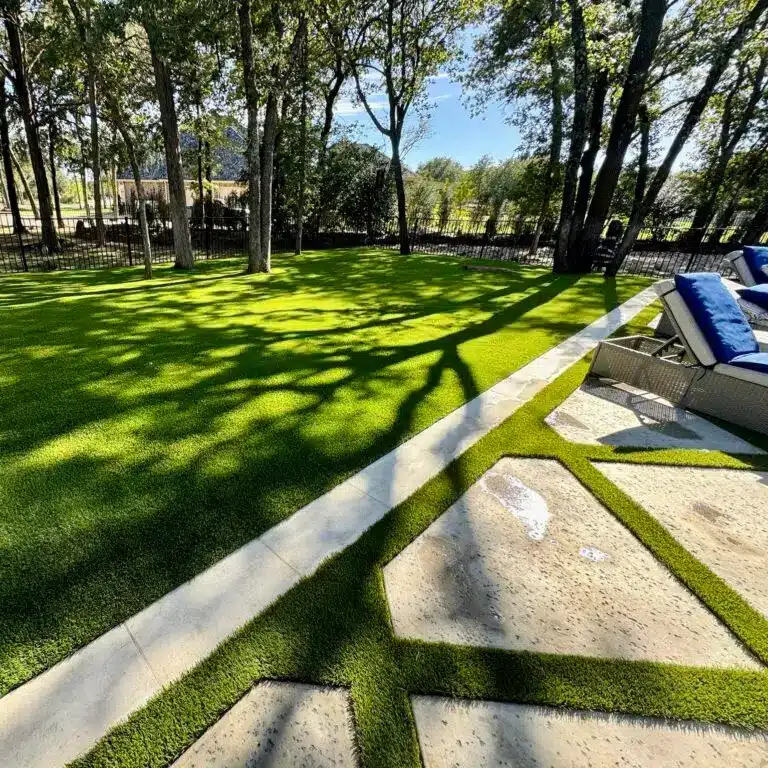
Artificial Grass on Clay in DFW: Fix Drainage Before Turf

Yes, you can install artificial grass on clay, but only if you first excavate and replace the clay with a permeable, compacted base and design drainage to carry water away from the turf. Skip the base and the drainage plan, and your lawn will hold water underneath, soften over time, and wear out long before it should.
TL;DR:
- Excavate deeper in persistently saturated spots or where drains need room, then separate clay from compacted aggregate with geotextile fabric.
- Grade the base away from structures toward an outlet; use a French drain for low edges or catch basins where runoff concentrates.
- Choose turf with perforated backing and a stated permeability rating, and confirm the complete system, including infill and any pad, suits local rainfall.
- A small yard with good drainage may suit DIY, but ponding, large areas, or complex drainage call for a contractor; work typically takes 3–4 days.
Table of Contents
- Your quick checklist for installing artificial grass on clay
- Preparing the site: excavation depth, compaction, and base materials
- Drainage strategies that keep clay yards from waterlogging
- Choosing turf and infill that won’t trap water
- Installing artificial grass on clay step by step
- How long it takes and what drives the cost
- Why Pave-N-Turf understands clay installs in DFW
- Managing expansion and contraction in clay substrates
- How seasonal clay movement affects turf durability over time
- Should you DIY or call a pro for a clay yard?
- Let Pave-N-Turf handle the excavation, base, and drainage for you
- FAQ
- Sources
Your quick checklist for installing artificial grass on clay
Let’s be real: clay is unforgiving if you rush the prep work. Before anything else, walk your yard after a rain and note where water pools or sheets across the surface. Those low spots tell you where drainage needs the most attention.
From there, a solid clay install follows a predictable order:
- Assess the site for low spots, slope, and existing runoff paths.
- Excavate to the recommended depth, removing the compacted clay layer where it’s holding water.
- Lay geotextile fabric where needed, then compact a crushed stone base and add bedding sand if your system calls for it.
- Install perimeter or French drains anywhere water tends to collect.
- Choose a permeable turf and infill, then secure all edges so nothing shifts later.
Handing this list to a contractor before work starts helps everyone agree on scope before the first shovel hits the ground.
Preparing the site: excavation depth, compaction, and base materials
Clay soil feels dense and sticky when wet, and it often cracks into chunks as it dries. A quick way to confirm what you’re working with is checking your area on the USDA Web Soil Survey, which maps soil types for most U.S. counties. It’s a helpful starting point, but soil can vary within a single yard, so an on-site look after excavation still matters.
Once you know you’re dealing with clay, here’s the general sequence:
- Excavate a modest depth of soil, going deeper in spots with persistent saturation or where drainage piping needs room.
- Lay geotextile fabric across the exposed clay to stop it from migrating up into the stone base over time.
- Add and compact a crushed stone or road base aggregate in lifts, checking compaction as you go rather than all at once.
- Bring in a bedding layer of sand if your turf system specifies one for leveling.
Pro Tip: Compact the base in thin layers rather than one thick pour. Thin lifts compact more evenly and reduce the risk of soft spots under the turf.
For larger projects or areas with chronic standing water, a contractor can run compaction testing to confirm the base meets target density before turf goes down.
Drainage strategies that keep clay yards from waterlogging
Clay particles pack so tightly that water has almost nowhere to go, which is exactly why drainage design matters more here than on sandy or loamy soil. Grading the base so it slopes gently away from structures and toward a drainage path does a lot of the work before you even add pipe.
For yards with real trouble spots, a few options work well together:
- A French drain with perforated pipe wrapped in fabric, placed along the low edge of the yard, channels water away from the turf base.
- Slot drains or catch basins make sense on flat yards or wherever runoff concentrates in one area, like under a down spout.
- Surface grading alone can solve mild pooling, but it won’t fix a yard with a genuine low point.
According to Synthetic Turf Council guidance, synthetic systems are built to let water percolate through the turf and base so it doesn’t sit on the surface, which means your base permeability and infill choice both need to support that flow. A simple way to check your work: pour a bucket of water over the finished base before laying turf and confirm it drains within a few minutes rather than sitting on top.
Choosing turf and infill that won’t trap water
Not every turf product handles clay-adjacent drainage challenges the same way, so a few specs are worth checking before you buy.
- Look for a permeable or perforated backing and ask the manufacturer for its stated permeability rating.
- Shorter, denser pile tends to drain faster than longer, loose pile, so match the product to how the space gets used, whether that’s a play area or a quiet side yard.
- High-purity silica sand is a common infill choice that adds weight and stability without blocking drainage, according to the Synthetic Turf Council glossary; coated sands and other non-toxic alternatives exist too, each with slightly different feel and permeability.
- Shock-attenuation pads, when used, can add cushioning and sometimes contribute to drainage, but confirm the pad’s permeability before assuming it works like open stone.
Before you commit, ask your installer how the full system, backing, infill, and pad, is rated to handle your region’s rainfall, not just the average forecast.
Installing artificial grass on clay step by step
With the base compacted and drainage routed, installation itself follows a tighter sequence than most people expect.
- Fine-grade the compacted base to a smooth, even surface.
- Roll out the turf, allowing it to acclimate to temperature for a couple of hours before cutting.
- Seam adjoining pieces using seam tape and adhesive, keeping blade direction consistent across seams.
- Secure all edges with nails, staples, or a rigid edge restraint so the perimeter can’t shift.
- Apply infill evenly, then brush the turf fibers upright to help the infill settle.
Pro Tip: A plate compaction test on the base, checked before turf goes down, is the fastest way to catch soft spots while they’re still easy to fix.
Protecting your drain lines during this phase matters too. Keep equipment off pipe runs and confirm water still flows freely through any French drains before the turf covers them for good. A final walk-through, checking seams, edges, and drainage flow, closes out the job.

How long it takes and what drives the cost
For an average residential yard, plan on roughly a day or two for site prep and excavation, another day for base installation and compaction, and a day for turf laying and finishing. Difficult clay or extensive drainage work stretches that timeline.
Several factors swing the price:
- The volume of clay removed and the amount of imported base material needed.
- Whether drainage piping or catch basins are part of the design.
- The grade of turf selected and its backing and pile specs.
- Labor costs tied to site access and yard complexity.
Poor existing drainage or a yard with tight side-gate access tends to add both time and cost, since equipment and material have to move through narrower spaces. If your property falls under an HOA, factor in review time before work can start.
Why Pave-N-Turf understands clay installs in DFW
Dallas-Fort Worth sits on soil that swings between heavy clay and rocky caliche, and we’ve built our installation process around that reality. We provide artificial turf and paving solutions with products designed to be low-maintenance and eco-friendly alternatives to address mud, water waste, and wear that natural grass struggles with in heat. Our reputation for craftsmanship shows up in consistently high Google and Yelp ratings across DFW, and our step-by-step install guide walks through the same process we use on-site.
Managing expansion and contraction in clay substrates
Clay swells when it absorbs water and shrinks as it dries out, a cycle that can shift anything sitting on top of it if the base isn’t built to resist that movement. This is why skipping the compacted stone layer causes more trouble on clay than on almost any other soil type: the base is what keeps your turf stable while the clay underneath keeps moving.
A properly compacted aggregate base acts as a buffer. It spreads weight evenly, resists the clay’s swelling pressure from below, and keeps the turf surface flat even as the soil beneath shifts seasonally. Geotextile fabric plays a supporting role here too, keeping the stone and clay layers separate so the base doesn’t lose its structure as the clay expands and contracts against it.

Edge restraints matter more on clay than on sandier soils for the same reason. A rigid perimeter, whether that’s metal edging or a paver border, holds the turf’s boundary in place even if the ground just beyond it heaves slightly during a wet season. Without that restraint, you may notice gaps opening at the edges or seams pulling apart after a few seasonal cycles.
None of this requires exotic materials. It just means the base depth, compaction, and edge detailing need to account for clay’s natural behavior rather than treating it like any other soil.
How seasonal clay movement affects turf durability over time
Clay soil doesn’t stay still through the year. It swells during wet months and pulls back as it dries in summer heat, and that seasonal rhythm puts slow, repeated stress on anything built above it.
A well-prepared base absorbs most of that movement before it ever reaches the turf. The compacted stone layer distributes the clay’s shifting pressure, and the geotextile fabric keeps the two layers from mixing as they move against each other season after season. Turf installed over a shallow or poorly compacted base, by contrast, tends to show subtle waviness or soft spots within the first year or two, especially near the edges where restraint is weakest.
Drainage plays into durability here as well. Clay that stays saturated for long stretches swells more and holds that swelling longer, which means a yard with working French drains or proper grading experiences gentler, more predictable movement than one where water has nowhere to go. Over several years, that difference shows up as a turf surface that stays flat and taut instead of one that develops dips where the base has settled unevenly.
The upshot is that durability on clay isn’t just about the turf product itself. It’s about how well the base and drainage system absorb the ground’s natural seasonal cycle before it ever reaches the surface you walk on.
Should you DIY or call a pro for a clay yard?
A small, naturally well-draining yard is reasonable to tackle yourself. Heavy ponding, large square footage, or complex drainage work calls for a pro, since warranty terms and proper compaction depend on getting the excavation right the first time.
— Everson
Let Pave-N-Turf handle the excavation, base, and drainage for you
Getting a clay yard right takes the kind of excavation, compaction, and drainage work that’s hard to get exactly right on a first attempt, and it’s exactly what we handle every week across Dallas-Fort Worth. For contractor-grade compaction specs and backfill guidance, resources like Cornelius Wrecking’s compaction guide outline the same density targets our crews work toward on-site.

Our services cover the full range a clay yard might need:
- Landscape Turf installation with proper base and drainage design.
- Pet Turf built for durability and easy cleanup in high-traffic areas.
- Playscapes and Golf and Putting Greens for specialized use cases.
- Landscape Pavers and Decorative Rock for complementary hardscape work.
If your yard holds water or you’re not sure what’s under the surface, reach out through our landscape turf page to request a quote and get a plan built around your actual soil.
FAQ
What happens if you just lay artificial grass on soil?
Laying turf directly on soil, especially clay, traps water underneath because the soil can’t drain fast enough on its own. Over time this causes soft spots, odor, and premature wear as the base shifts beneath the turf.
Can you lay turf on top of clay?
Natural sod can be laid over clay, but it typically struggles with poor drainage and compaction issues long term. Artificial turf works on clay only when the clay is excavated and replaced with a compacted, permeable base designed for drainage.
What to put under artificial grass on dirt?
A permeable crushed stone or aggregate base, often paired with geotextile fabric to separate it from the native soil, forms the standard foundation. A bedding sand layer may follow depending on the turf system’s specifications.
Can I just lay artificial grass on top of dirt?
No, laying turf straight onto bare dirt skips the compaction and drainage layer that keeps the surface stable and dry. Without that base, the turf will shift, pool water, and wear unevenly within a short time.
Sources
For soil mapping, the USDA Web Soil Survey is a solid starting point. For technical base and drainage standards, the Synthetic Turf Council’s guidelines outline construction considerations worth reviewing before any install.