Decorative Rock Around Pools: Pair Rock Looks With a Safer Base

Decorative rock is a practical, low-maintenance choice for pool surrounds when it sits on a proper base with solid edging and good drainage. We would start with pea gravel, crushed stone, river rock, flagstone, or decomposed granite. Before you buy anything, check two things: how slip-resistant the surface is where bare feet land, and where the water will go.
TL;DR:
- Use textured travertine, textured porcelain, or tumbled stone where wet bare feet enter the pool; reserve loose gravel and river rock for areas farther away.
- For a firmer path, compact angular crushed stone or decomposed granite; pea gravel feels softer but shifts and needs edging plus occasional replenishment.
- A base can use ASTM #2 subbase, 4 inches of ASTM #57, and 2 inches of ASTM #8 bedding; light foot traffic may need only #57.
- Grade the surface to send runoff away from the pool, keep soil out with permeable geotextile, and install firm edging to prevent shifting and erosion.
- Clear debris, rinse gently, and replace stone when bare patches or exposed soil appear; hire a professional for persistent erosion, failed drainage, or regrading.
Table of Contents
- 1. Which decorative rock types work best around a pool?
- 2. How do you keep pool-edge rock from being slippery?
- 3. What does a solid installation look like?
- 4. How can you mix rock with pavers, turf, and plants?
- 5. How do you maintain rock around a pool?
- 6. When should you DIY and when should you hire a pro?
- 7. Ready for decorative rock that drains well and feels safe underfoot?
- FAQ
- Sources
1. Which decorative rock types work best around a pool?
Each rock does a different job, so match the stone to how you use the space. Park Magazine NY describes the basic split well: rounded gravel feels soft but shifts, angular crushed stone locks together, and river rock is mainly decorative.
- Pea gravel: Rounded stones about 3/8 inch across, soft underfoot and great for casual, natural looks. It shifts, so it needs firm edging and occasional topping up.
- Crushed limestone or granite: Angular pieces that lock together when compacted. This is the better pick for higher-traffic paths where you want stability.
- River rock: Smooth, rounded stones that shine as accents and in drainage beds. Keep them out of the main walking surface near entries.
- Flagstone: Irregular natural stone that gives you a finished patio look and a steady surface for stepping zones.
- Decomposed granite: A compactable, semi-firm finish that works well for paths and transitions.
For color, pull a shade from your decking or pool finish and stay within a restrained range of tones. Warm tan gravel pairs nicely with light concrete, while gray crushed stone suits darker plaster. If you want more on sizing, our decorative rock ideas guide covers rock sizing.
2. How do you keep pool-edge rock from being slippery?
Texture matters as much as the material itself. Genrose notes that natural stones like travertine should be chosen in textured or tumbled finishes so they grip when wet, especially where people enter and exit the water.
So for the zones where wet, bare feet land, choose textured travertine, textured porcelain pavers, or tumbled stone. Loose rock works well a step or two back from the water, where it can add looks without adding risk.
Skip very smooth river rock anywhere people step in and out barefoot. It rolls, it hurts, and it gets slick. Keep step and transition dimensions consistent too, because uneven treads trip people faster than any wet surface. Our guide to pavers for a pool deck goes deeper on grippy options.
Pro Tip: Wet a sample tile or paver, step on it barefoot, and decide before you order a full load.

3. What does a solid installation look like?
Most rock problems come from what’s underneath it. Follow this order:
- Excavate and grade so the surface slopes away from the pool.
- Lay geotextile over the prepared soil.
- Spread and compact the base aggregate.
- Install the edge restraint.
- Place your chosen rock and rake it to finish depth.
Geotextile keeps the base separate from the soil and stops soil from migrating up into the stone. ICPI explains that you should choose fabric with high permeability, using non-woven needle-punched types for sand and gravel soils and woven high-permeability types for weaker silts and clays. Our post on landscape fabric mistakes under rock shows what goes wrong when fabric is chosen carelessly.
For the base, a common layered setup uses an ASTM #2 stone subbase, a 4 inch layer of ASTM #57, and a 2 inch ASTM #8 bedding layer, according to ICPI. For light foot traffic, a #57 base over geotextile is sometimes enough, but #2 gives better support under heavier loads.
Pick an edge that fits your look:
- Steel: Thin, crisp, and nearly invisible.
- Stone or concrete: Heavy, permanent, and easy to match to decking.
- Paver edging: Gives a clean joint against turf or a patio.
For drainage, keep soil from washing into the rock, and send runoff away from the coping toward a lawn, bed, or drain. Where a bayside or flood-prone lot sits near the water, Bayfair Custom Homes shows how outdoor living areas can be planned around site conditions.
4. How can you mix rock with pavers, turf, and plants?
A few repeatable patterns make the design feel planned rather than dumped:
- Banding: Run a narrow band of fine gravel beside the coping, then place larger stones as an outer accent.
- Scale rule: Use small aggregate near walkways and bigger stones in decorative islands and drainage beds.
- Transitions: Add a slim paver band or stepping stones where rock meets decking or turf so the edge looks intentional.
- Planting pockets: Choose splash-tolerant, low-care plants and let rock mulch frame them.
- Mini-scheme one: A pebble band along the deck with a flagstone path leading to a seating area.
- Mini-scheme two: A river-rock dry creek that quietly hides a drain.
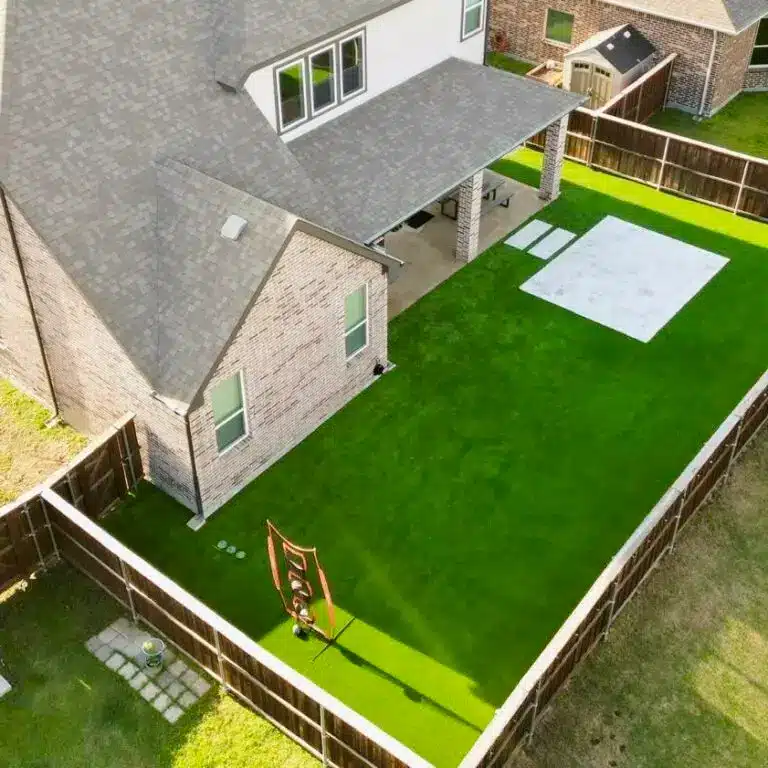
Turf pairs especially well with rock borders because both stay tidy with little work. If you are weighing that combination, our landscape turf page shows what it looks like.
5. How do you maintain rock around a pool?
A little routine care keeps everything neat and safe:
- Clear leaves and debris often, and rinse with a hose or a low-pressure wash.
- Let a good base and the right geotextile handle weeds, and avoid fabric that traps fines and clogs drainage.
- Replenish when you see bare patches, visible soil, or compacted spots. Measure the area in square feet and multiply by your depth before ordering.
- Call a pro for lasting erosion, drainage that fails, or regrading.
6. When should you DIY and when should you hire a pro?
At Pave-N-Turf we install decorative rock, pavers, and turf, and pool-adjacent projects almost always hinge on drainage and edging. The usual DIY slip-ups we see are a thin base, no geotextile, and edging that gives way. We avoid them by grading first and building from the bottom up. Bring three things to any installer: a drainage plan, your preferred edge restraint, and a rock sample in the color you like.
— Everson
7. Ready for decorative rock that drains well and feels safe underfoot?
We install decorative rock, pavers, and turf in ways that address the drainage and slip-resistance points above.

- Explore pool-edge ideas.
- Request an estimate for your own pool area.
- Ask us about pairing rock with pavers or turf.
Start with our decorative rock service page, or look at landscape pavers if you want a firmer entry zone.
FAQ
Where is the best place to get free rocks?
Online classifieds list free rock often, but be careful. Posts like this one often describe rock mixed with dirt and organic debris and note you usually have to haul it yourself. For poolside use, clean, consistent, purchased stone is the safer pick.
What is the best paver to use around a pool?
Choose a paver with a textured or tumbled finish so it grips when wet. Textured travertine and textured porcelain pavers both fit that need, especially at entry and exit points.
Which material is best for a swimming pool surround?
It depends on the zone. Use textured pavers or tumbled stone where people walk wet and barefoot, and use compacted crushed stone or decomposed granite for paths set back from the water.
What is the cheapest thing to put around a pool?
Loose gravel over a proper base is usually the most budget-friendly surround, though it needs edging and occasional replenishing. Free rock can look cheaper, but contaminants and uneven sizes can cost you more later.
Sources
- Genrose
- The Use of Geotextile in Permeable Pavement
- Gravel, Flagstone, or Natural Stone — How the Material You Choose Shapes the Way an Outdoor Space Looks and Functions – Park Magazine NY