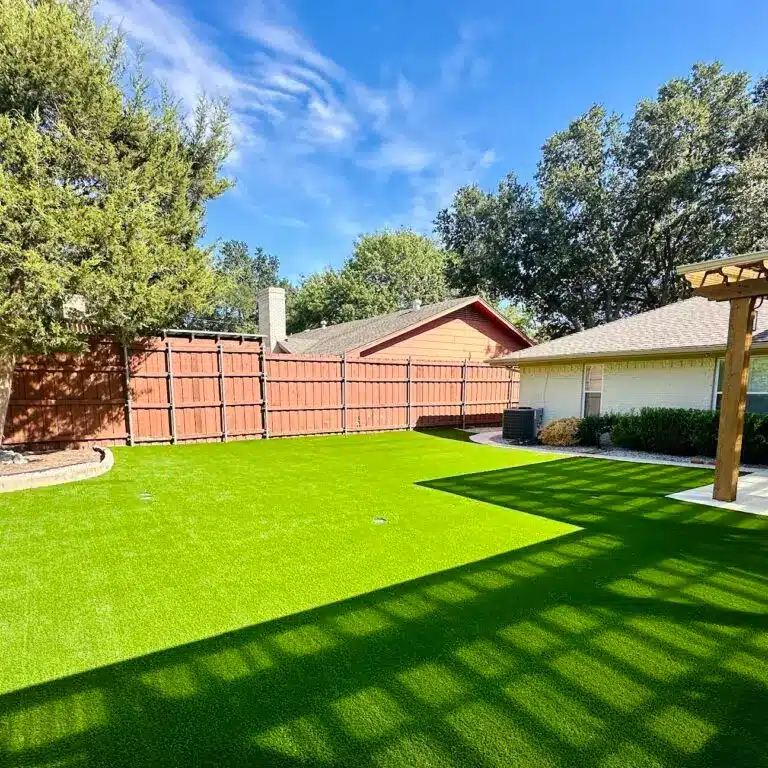
Eco-Friendly Turf Materials: What to Look For in Artificial Grass

The greenest artificial turf is not one magic material. It is a system: fibers, backing and infill chosen well, drainage built correctly, and a lawn that stays in service for a long time. Turf saves irrigation water and removes mowing and fertilizer. The materials you choose decide how much of that benefit you keep. This guide shows what each layer is made of, which options have the lowest footprint, and what to ask before you sign for an install.
TL;DR
- Artificial turf needs no irrigation or fertilizer, so the biggest gain is water. Fiber, backing and infill choices decide the rest of the footprint.
- Organic infills such as cork or coconut fiber have the lowest impact of the infill types reviewed, and a shock pad can reduce how much infill you need.
- No single federal label proves turf is “eco-friendly.” Ask for the material makeup, testing results and a drainage plan.
- Surface heat is a real safety point for kids and pets. Plan shade and cooling habits.
- Ask what happens to the turf at the end of its life. Recycling is possible but not guaranteed everywhere.
Table of Contents
- What “eco-friendly” can honestly mean for turf
- What artificial turf is made of
- Where turf does save resources
- Drainage: the part that protects the ground
- Microplastics and chemicals: what the science says
- Heat: plan the yard for kids and pets
- Lifespan and end of life
- A buyer’s checklist for greener turf
- Eco-friendly turf in Dallas-Fort Worth with Pave-n-Turf
- Our perspective
- FAQ
- Sources
What “eco-friendly” can honestly mean for turf
Turf is a manufactured product, so “eco-friendly” is a matter of degree. The New Jersey Department of Environmental Protection (the state’s environmental regulator) frames sustainability as a lifecycle question: water saved during use is one part, and feedstocks, heat, chemical release, replacement and disposal are the others. That is a useful way to shop. You are not looking for a green badge. You are looking for good answers on five things:
- What the fibers and backing are made of.
- What the infill is, and how much of it there is.
- Whether the product has been tested for chemicals.
- Whether water drains through the system properly.
- How long it lasts, and what happens afterward.
The U.S. Environmental Protection Agency (EPA) warns consumers to be cautious with vague labels. Its Indoor AirPlus guidance says words like “environmentally friendly,” “eco safe” or “green” alone mean little, and that third-party labels tied to emission standards are the better signal. Use that rule on any turf brochure, ours included: look for specifics.
What artificial turf is made of
Every turf system has three layers that matter for the environment: the blades, the backing and the infill.
Blades (fibers). University of Florida’s IFAS Extension notes that artificial turf typically uses nylon, polypropylene or polyethylene fibers attached to a reinforced backing. These are plastics, so the fiber is where petroleum-based feedstock enters the picture.
Backing. A 2025 peer-reviewed case study reports that turf backing may contain polyurethane, latex rubber, polyethylene, polypropylene or polyamide. Backing is the layer that holds the blades and lets water through, so its makeup and its perforation both matter.

Infill. This is the granular material between the blades. It adds weight, supports the blades and, in some uses, cushions. The Trust for Public Land lists sand, recycled-tire crumb rubber, wood, cork, coconut fiber, walnut shells, rubber, polymer beads and foams among the options in use.
How the infill choices compare
| Infill type | What it is | What to know |
|---|---|---|
| Silica sand | Natural mineral | Common, simple and familiar, but heavy and not organic |
| Coated sand | Sand with a polymer coating | Coating can add a material question worth asking about |
| Cork, coconut fiber, walnut shell | Organic, renewable | Lowest environmental impact among infills reviewed |
| Recycled tire crumb (SBR) | Shredded tires | Contains chemicals of potential concern, per California regulators |
| EPDM, TPE and other polymers | Engineered rubbers and plastics | Polymer infills rank higher in impact than organic ones |
A 2024 scoping review from Norway found that organic infills have the lowest environmental impact relative to polymer infills, and that a shock pad can reduce impact by cutting the amount of performance infill needed. The same review notes that research on alternative infills is still limited, so ask for the specific product’s data rather than assuming. California’s Department of Toxic Substances Control (DTSC) also notes that crumb rubber made from recycled tires contains chemicals of potential concern. For a yard where kids and pets spend time, that points you toward sand or organic options over tire crumb.
For a deeper look at amounts and types for a home lawn, see our guide to artificial grass infill.
What about “recycled” and “plant-based” claims?
Recycled content sounds green, but source matters. New Jersey’s DEP notes that newer turf may include recycled materials, yet recycled EPDM or SBR can bring uncertainty, since they may carry contaminants from automotive foam, coated sand or shredded tires. Plant-based content is a growing category, with some manufacturers using sugarcane-derived polymers and soybean-oil backing. The useful question is the same for both: what is the material, what share of the product is it, and what testing backs it up?
Where turf does save resources
Water is the clearest benefit. The 2025 case study estimates artificial turf can avoid roughly 0.5 to 1 million gallons of irrigation water per average U.S. football field per year, while noting that manufacturing still uses substantial water. A home yard is far smaller, but the logic scales down: no sprinklers, no fertilizer. UF/IFAS confirms that synthetic turf needs no supplemental irrigation or fertilization.
For Texas homeowners, that also means no mowing. No gas mower, no trimmer, no weed products. Those gains are real, and they are why many DFW households switch.
We cover the broader picture in our posts on going green with artificial turf and eco-friendly landscaping with artificial lawn turf.
Drainage: the part that protects the ground
The same 2025 study reports that long artificial turf installations can show runoff levels comparable to asphalt, about 56%, because plastic replaces direct soil contact. That is a design issue, and a good installation addresses it. A properly prepared base with the right aggregate lets water move down and away instead of sheeting off.
This matters a lot in North Texas, where heavy clay soil drains slowly. If the base is wrong, you get puddles, odors and a surface that behaves like pavement. Two of our guides go into the detail: fixing drainage before turf on clay and a drainage checklist for pet turf. When you compare quotes, ask how the base is prepared, because it affects both performance and environmental impact.
Microplastics and chemicals: what the science says
Blades wear and weather, and worn plastic sheds small particles. DTSC cites an estimated annual fiber-mass loss of 0.5 to 0.8% for 40 to 65 mm turf. Practical steps follow from that: choose durable fibers, avoid aggressive brushing, and do not hose debris into storm drains.
On chemicals, the New Jersey DEP’s memo says PFAS (a family of long-lasting industrial chemicals) can be present in turf components, and that the types and their release during use are not yet established well enough for a full assessment. That is the reason to ask for documentation. DTSC recommends regular testing of the product for organic compounds and metals to inform decisions about installed components.
For parents, the best-studied case is recycled tire crumb. The EPA’s federal research found that only small amounts of most organic chemicals were released into air, and metals showed low bioaccessibility, under 1 to 3% in simulated biological fluids. Exposures in the studied fields were likely limited. Choosing a sand or organic infill gives you an even simpler answer.
On “low-VOC” turf: VOCs are gases released by some materials. A California study found that most air samples above crumb-rubber fields were below detection, and detected levels were below health-based screening levels. If a product advertises low emissions, look for a named third-party standard such as CDPH Standard Method V1.2-2017, the benchmark EPA points to.
Heat: plan the yard for kids and pets
Safety first: turf gets hot in Texas sun. Western Resource Advocates reports that artificial turf can reach temperatures up to 80°F above the ambient air temperature and links excessive heat to heat stress and turf burns, particularly for children and pets.
Simple habits keep play safe:
- Put shade structures or trees over play areas and pet zones.
- Check the surface with your hand before children or dogs go out on hot afternoons.
- Rinse the surface with water to cool it before use in peak summer.
- Schedule play for mornings and evenings from June through September.
If you have a pet area, our pet turf page explains how we build these spaces to be clean and easy to maintain.
Lifespan and end of life
Longer life is the simplest way to lower a product’s footprint, because replacement is where plastic waste and manufacturing energy come back. The New Jersey DEP’s review says properly maintained fields generally last approximately 10 to 12 years before replacement. That figure is for heavily used sports fields. Home lawns see far lighter use, which is why we cover a 15 to 20 year view of the tradeoffs for residential installs.
What happens next depends on access. DTSC states that evidence of recycling artificial turf is minimal, that reuse is more common for infill than for blades and backing, and that burning turf containing fluoropolymers can form toxic combustion products. So never burn old turf.
Recovery is possible, though. A 2024 trade report on a stadium replacement describes infill being separated from the carpet, with the carpet sent to a recycling partner and converted into products like planters and park benches. Because access, contamination and component separation vary by location, the best move is to settle your plan before installation. We walk through local options in artificial grass recycling for Texas homeowners.

A buyer’s checklist for greener turf
Use this list when you compare quotes for a lawn, pet area, playscape or putting green:
- Ask for the material makeup. Fiber type, backing type and infill type, in writing.
- Prefer sand or organic infill for areas where kids and pets spend time, and ask about a shock pad under playscapes.
- Ask for testing documentation. Organic compounds and metals, as DTSC recommends, and any emissions standard named.
- Question vague labels. “Green” or “eco” without a named standard is not information.
- Check the base design. Aggregate depth, compaction and how water leaves the site, especially on clay.
- Plan for shade and heat. Especially for playscapes and pet runs.
- Ask about end of life. Who removes the turf, and whether any recovery option exists locally.
The New Jersey DEP’s review makes the underlying point: the U.S. market has no single federal consumer certification proving turf is universally eco-friendly, so each of these items has to be judged on its own.
Eco-friendly turf in Dallas-Fort Worth with Pave-n-Turf
We install artificial turf for landscapes, pet areas, playscapes, putting greens and commercial properties across Dallas-Fort Worth and Austin, along with landscape pavers and decorative rock. Our turf is designed to cut the upkeep, water use and mud that natural grass brings in the Texas climate. If you want a lawn that fits your yard, start with our landscape turf service, or tell us about your project through our site and we will talk through the materials with you.

Bring the checklist above. We are glad to go through it with you.
Our perspective
We are a veteran-owned team, and we install turf because we have watched what natural grass asks of a North Texas yard: water every week, mowing, patches, mud and dust where the kids and dogs play. A well-built turf lawn takes that off your list for years.
The greenest turf lawn is the one that is installed once, built right and left alone. That is why we care about craftsmanship more than any single material claim. A solid base, proper drainage and careful seams decide whether a lawn performs for the long haul, and a lawn that performs is a lawn that does not get torn out early.
Our approach to materials is simple: choose them for the people using the space. A putting green, a pet run and a front yard each ask for something different, and we plan each one that way. We would rather answer your questions about infill, heat and drainage before the project than after.
If you are weighing turf against a thirsty lawn, we think you will find it a practical, low-maintenance way to keep your yard green through a Texas summer.
Everson
FAQ
Is artificial grass eco-friendly?
It depends on what you count. Turf removes irrigation, fertilizer and mowing, and a 2025 study estimates large water savings on sports fields. Materials, drainage and lifespan decide the rest, so choose carefully and plan for the end of its life.
What is the most eco-friendly infill for artificial turf?
Organic infills such as cork and coconut fiber had the lowest environmental impact among those reviewed in a 2024 scoping review. Silica sand is another common option for homes. Recycled tire crumb contains chemicals of potential concern, so many families choose sand or organic infill for play and pet areas.
Does artificial turf release microplastics?
Turf blades can shed small plastic particles as they wear and weather. DTSC cites an estimated annual fiber-mass loss of 0.5 to 0.8% for common blade lengths. Durable fibers and gentle maintenance help, and keeping debris out of storm drains is a good habit.
Can artificial turf be recycled?
Sometimes. Reuse is more common for infill than for blades and backing, and recycling programs are not available everywhere. Decide how the turf will be removed before installation, and never burn it.
How hot does artificial turf get?
It can reach up to 80°F above the air temperature in direct sun, according to Western Resource Advocates. Shade, morning and evening play, and a quick rinse before use keep kids and pets comfortable.
Sources
- Synthetic Turf: A Review of the Current Science (New Jersey DEP, 2025)
- PFAS in artificial turf memorandum (New Jersey DEP, 2023)
- Synthetic Turfgrass and the Nine Principles (UF/IFAS, 2024)
- Artificial Turf Versus Natural Grass: A Case Study (MDPI Sustainability, 2025)
- Environmental impacts of artificial turf: a scoping review (2024)
- Background Document on Candidate Chemicals in Artificial Turf (California DTSC, 2024)
- Safety Study of Artificial Turf Containing Crumb Rubber (OEHHA, 2010)
- Indoor AirPlus: How to Find Compliant Building Materials (EPA, 2024)
- The Use of Artificial Turf in Parks and Schoolyards (Trust for Public Land, 2024)
- Federal Research on Recycled Tire Crumb Used on Playing Fields and Playgrounds (EPA)
- Is Artificial Turf a Beneficial Water Conservation Tool? (Western Resource Advocates, 2022)
- Gillette Stadium installs new FieldTurf Core (Sports Field Management, 2024)