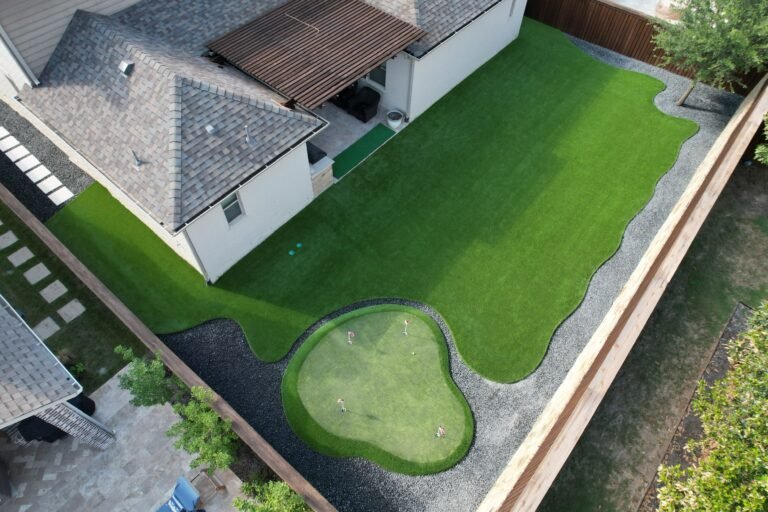
$8,000–$15,000 Office Putting Greens: What Office Managers Must Ask
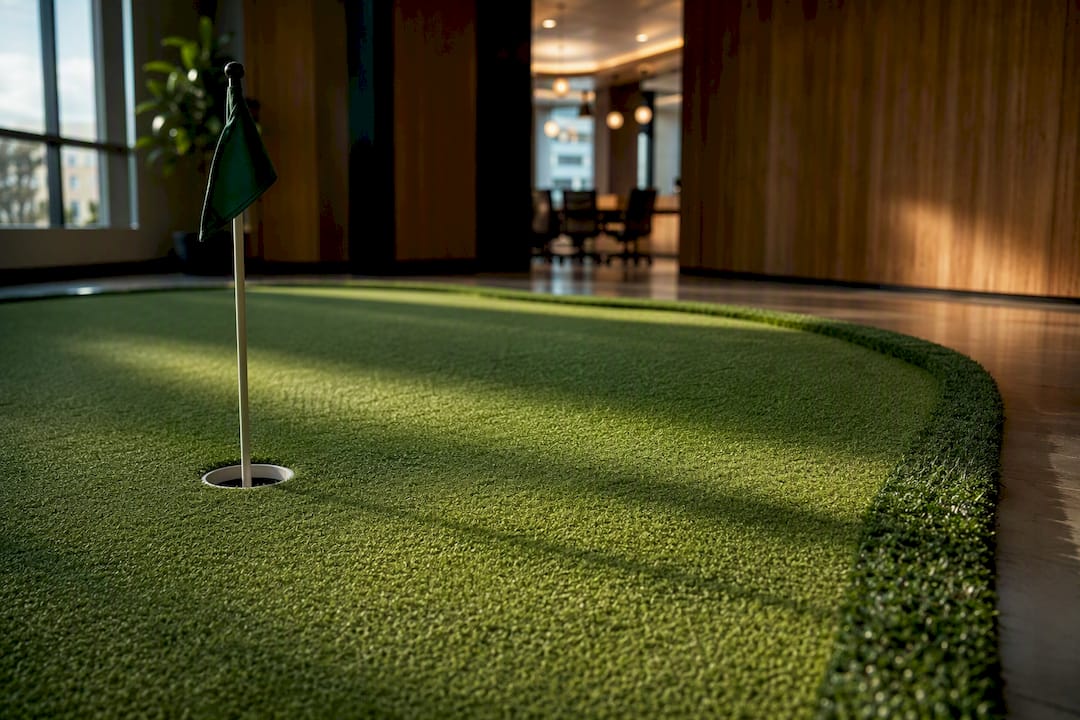
A custom office putting green is a permanent artificial-turf installation, not a portable mat, and it’s worth building right the first time. For anything beyond a small, simple layout, hire a specialist installer who can guarantee proper base work, drainage, and consistent ball roll. A company like Pave-N-Turf handles the whole process and delivers a low-maintenance, realistic-playing surface that holds up for years.
TL;DR:
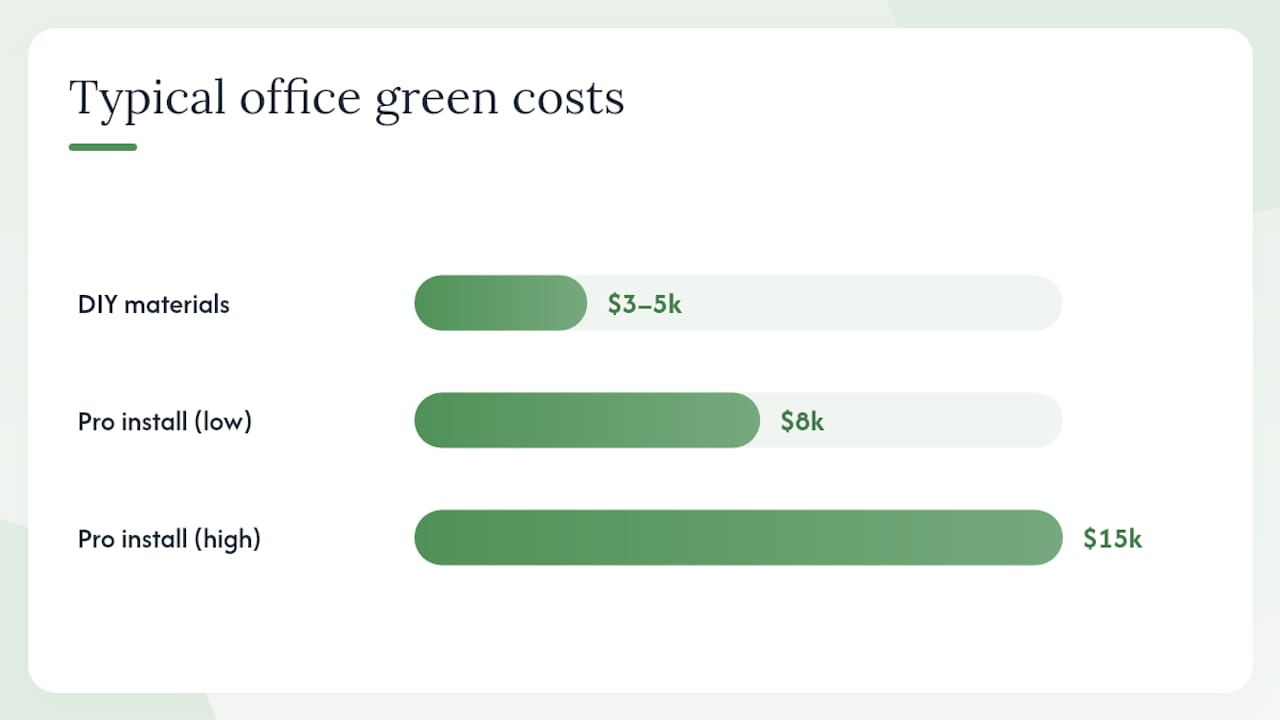
- Professional installation typically costs between $8,000 and $15,000 for a 500-square-foot green, with larger or more complex layouts reaching the higher end.
- A straightforward small office green can usually be completed in a single day, while larger projects with multiple contours or drainage needs may take several days.
- DIY installation is only feasible for tiny, flat, low-stakes greens; any project involving contours, drainage, or indoor/roof access requires professional expertise.
- Proper base compaction, grading, and drainage are critical to prevent wrinkles, dips, or water pooling, and should be handled by experienced installers.
- Regular maintenance, including weekly brushing and infill top-ups, is essential for years of consistent, true play.
Table of Contents
- What Makes an Office Putting Green Different From Landscape Turf
- Should You Hire a Pro or Try a DIY Kit?
- How Does Office Putting Green Installation Actually Work?
- What Does an Office Putting Green Cost and How Long Does It Take?
- Contractor Checklist: Questions, Documents, and Red Flags
- Keeping the Green Playing True Over Time
- What Installers Actually See on Site
- How Pave-N-Turf Builds Office Putting Greens
- Sources
- FAQ
What Makes an Office Putting Green Different From Landscape Turf
Putting-green turf is built for a completely different job than the turf on your front lawn. Pile height runs shorter, fiber density is tighter, and face weight is calibrated so a golf ball rolls true instead of wobbling over shaggy blades. The backing matters too. Landscape turf backing flexes for foot traffic; putting-green backing needs to stay flat and dimensionally stable under a rolling ball for years.
Infill is where green speed gets tuned. Silica sand stabilizes fibers and firms up the roll, while some systems skip infill and rely on dense, engineered pile instead.
- Silica sand infill: adjustable speed, common for outdoor greens with more surface area
- Foam-backed, low-infill systems: consistent firmness, popular for compact office footprints
- Placement: an indoor office green, a rooftop deck, and a courtyard each demand different base and drainage engineering
An indoor commercial green often uses a different base system than an in-ground outdoor install, since it needs to tolerate heavy daily foot traffic without the benefit of natural soil drainage underneath.
Should You Hire a Pro or Try a DIY Kit?
Building a green that plays true is a precision job, and that’s exactly where DIY kits tend to fall apart. Professionals bring compaction equipment, laser-level grading, seam-welding technique, and correctly set cup sleeves. Skip any one of those steps, and the green looks fine for a month before it doesn’t.
Common DIY failure points show up fast:
- Wrinkled or bunched turf from inadequate stretching and seaming
- Standing water from a base that wasn’t graded for fall
- Inconsistent ball roll from uneven compaction under the turf
- Cups that shift or “volcano” because the sleeve wasn’t set properly
Professional installation is generally recommended whenever precise contour shaping, fringe integration, or drainage control is involved, and an office space with hard flooring, rooftop access, or tight indoor clearances almost always fits that bill. DIY makes sense only for a tiny, flat, low-stakes putting strip where a bad roll costs you nothing but pride.
Pro Tip: If budget is tight, ask your installer about a hybrid approach: pros handle the base and drainage, and you assist with turf laying or brushing under their supervision.
How Does Office Putting Green Installation Actually Work?
Every solid installation follows the same sequence, whether the green sits in a corner office or a rooftop courtyard. Knowing these stages lets you read a contractor’s proposal and know exactly what you’re paying for.
- Site assessment and design. The installer walks the space, checks access and utilities, and maps cup locations and desired contours around your layout.
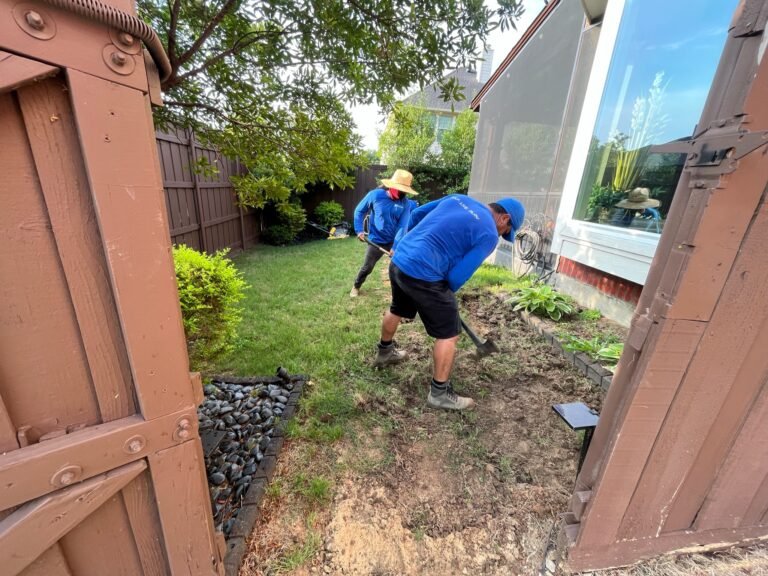
- Excavation. Crews remove existing surface material to a depth that accommodates the full base system, usually several inches deeper than a standard landscape turf job.
- Aggregate base construction. Crushed aggregate goes down in compacted lifts. Base compaction is the single biggest factor in whether a green stays flat or develops wrinkles and dips over time.
- Fine grading and contour shaping. This is where slope and break get built in, with fall rates set so water sheds correctly instead of pooling on the surface.
- Drainage installation. Indoor and rooftop greens especially need engineered drainage paths, since there’s no surrounding soil to absorb runoff.
- Turf layout and seaming. Panels get cut, positioned, and seamed so the joins disappear under normal lighting.
- Cup sleeve installation. Sleeves are set, often in concrete, to prevent shifting or the “volcano effect” around the hole.
- Infill application. Sand or specialty infill is broadcast and worked into the pile to hit the target green speed.
- Brushing and surface tuning. Fibers get lifted, infill gets leveled, and the installer test-rolls balls across multiple angles to confirm consistency.
At delivery, inspect three things closely: seams should be invisible at a normal standing distance, cups should sit perfectly flush with the surface, and a ball should roll true whether you’re putting uphill, downhill, or across a break. These stages match the standard installation sequence used across the industry, and any contractor worth hiring should be able to walk you through each one without hesitation.
What Does an Office Putting Green Cost and How Long Does It Take?
Price swings widely based on size, complexity, and turf grade, so treat any flat “per green” quote with suspicion until you see a per-square-foot breakdown.
- Entry-level turf and simple, flat layouts: lower end of the range
- Mid-grade turf with moderate contours: middle of the range
- Premium turf, complex breaks, and full drainage engineering: top of the range
For context, DIY materials for a roughly 500-square-foot green often run $3,000 to $5,000, while professional installation of a similar footprint commonly falls between $8,000 and $15,000. That gap covers labor, base materials, drainage engineering, and the equipment needed to compact and grade correctly, which is exactly the work that fails silently in a DIY build.
Timeline follows a similar pattern. A small office green with a simple layout often wraps in a single day once excavation starts. Larger commercial projects with multiple contours, drainage runs, or tight building access can stretch across several days. Most reputable installers ask for a site visit before quoting, so build a week or two of lead time into your planning before you’re ready to book a date.
Ask about warranty terms up front. A workmanship warranty covering seams, base settlement, and drainage separately from a manufacturer’s turf warranty tells you the installer stands behind the build, not just the material.
Contractor Checklist: Questions, Documents, and Red Flags
A good proposal reads like a spec sheet, not a sales pitch. Bring this list to every call.
Ask directly:
- How many putting greens have you installed, and can I see photos of finished projects?
- What’s your base depth and compaction method for this specific site?
- What drainage plan do you recommend, and why?
- How do you install and secure cup sleeves?
- What warranty covers workmanship separately from turf material?
- Are you licensed and insured for commercial installation work?
Documentation to request:
- Project photos from comparable jobs (indoor, rooftop, or office settings if possible)
- Client references you can actually call
- Turf spec sheets showing pile height, face weight, and backing material
- A line-item proposal separating base, drainage, turf, seaming, and cup work
A clear line-item proposal makes it far easier to compare competing bids and catch a lowball quote before it becomes an expensive lesson.
Red flags to walk away from:
- Vague or missing base specifications (“we’ll figure that out on site”)
- No project photos or client references offered
- A warranty that’s verbal only, with nothing in writing
- A bid dramatically lower than competitors with no explanation of what’s cut
Pro Tip: If a quote comes in far below everyone else’s, ask specifically what base depth and drainage work it includes. Cheap bids usually cut corners exactly where you can’t see them once the turf goes down.
Keeping the Green Playing True Over Time
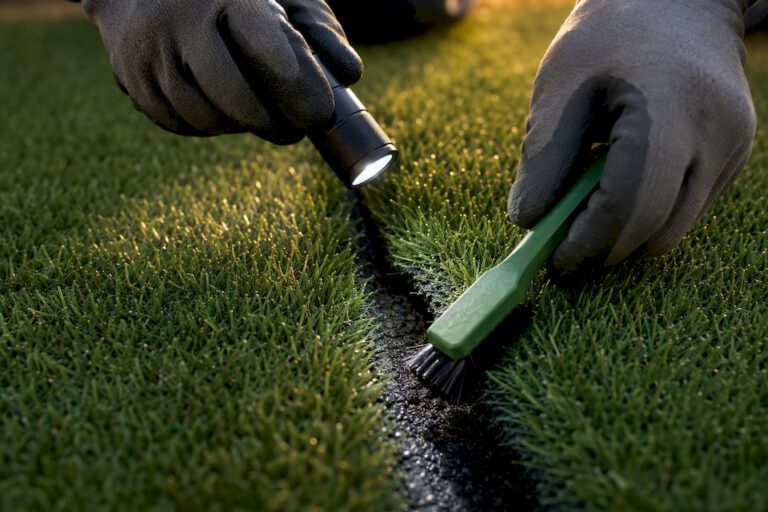
An office putting green rewards a small amount of routine attention with years of consistent play. Weekly brushing lifts fibers that get matted down by foot traffic and rolling balls, which keeps the roll predictable instead of gradually slowing in high-use spots.
- Brush fibers weekly to prevent matting and directional wear
- Clear leaves, dust, and debris before they work into the infill
- Spot-clean any spills right away, especially near break rooms or entrances
- Check infill depth every few months and top up low spots
- Inspect seams and cup sleeves annually for shifting or separation
Regular brushing and infill top-ups preserve fiber uprightness and consistent ball roll far more reliably than any one-time fix after the surface has already degraded. A well-built, well-maintained green can play true for well over a decade indoors, though UV exposure and heavy traffic shorten that window outdoors without periodic care. Most installers, including Pave-N-Turf, offer ongoing maintenance plans if you’d rather not manage it in-house.
What Installers Actually See on Site
Every office putting-green project has a surprise waiting in it. Sometimes it’s a utility line running exactly where the cup was supposed to go. Sometimes it’s a rooftop with a drainage slope nobody accounted for on the original floor plan, or an indoor space where the existing subfloor can’t take the base depth a proper green needs without raising the finished height awkwardly.
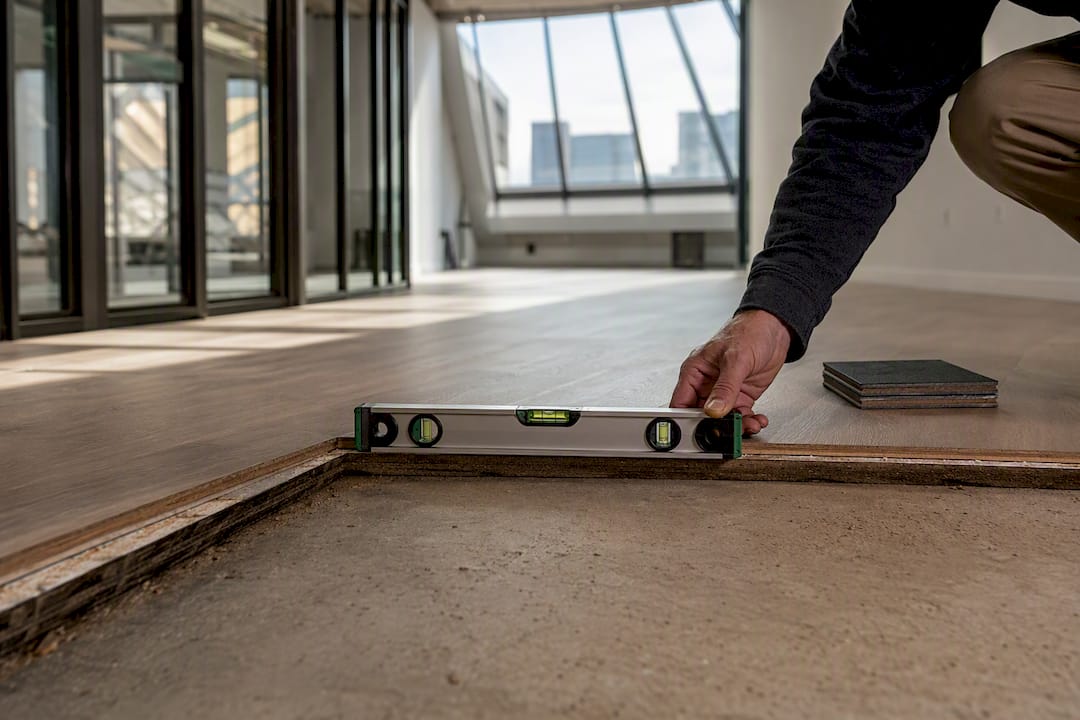
Good installers plan for this before ground ever breaks. That means walking the site early, checking access for equipment, and confirming drainage capacity rather than assuming it. One recent commercial buildout needed a redesigned drainage path after an initial walkthrough revealed a rooftop drain that couldn’t handle the extra runoff. Catching that before excavation started saved the client a costly mid-project change order.
If you’re preparing a brief for estimates, note anything unusual about access, flooring type, or existing drainage. The more detail you hand a contractor up front, the fewer surprises show up once work is underway.
— Everson
How Pave-N-Turf Builds Office Putting Greens
Pave-N-Turf is the direct alternative to hiring a generalist landscaper for this kind of project. Where a generalist might treat your putting green like any other turf job, we handle it as its own discipline. Every install starts with a site visit covering base depth, drainage capacity, cup placement, and turf grade before we ever write a number down.
You get a line-item proposal, not a lump-sum guess, so you can see exactly what you’re paying for in base construction, drainage, turf, seaming, and cup installation. We serve Dallas-Fort Worth and Austin property managers, office decision-makers, and homeowners who want a green that plays consistently for years, not just for the first ribbon-cutting putt. If your project also needs perimeter finishing, our landscape paver options integrate cleanly around a putting green edge.
Ready to move forward? Request a site visit through our golf and putting greens page and we’ll walk your space, answer your base and drainage questions directly, and put together a proposal you can actually compare against other bids.
Sources
- Putting greens — installation (Turf Network)
- A Guide To Installing An Artificial Putting Green | Turf Tek USA
- Commercial vs Residential Putting Greens: Things to Know Before Installation (Back9 Greens)
- How to make your backyard putting green PGA-level quality (Synthetic Grass Warehouse)
FAQ
How Much Does an Office Putting Green Cost?
Professional installation of a roughly 500-square-foot green commonly runs $8,000 to $15,000, depending on turf grade, contours, and drainage needs.
How Long Does Installation Take?
A small, straightforward office green often finishes in a single day, while larger commercial projects with multiple contours or drainage runs can take several days.
Can I Install an Office Putting Green Myself?
DIY works only for tiny, flat, low-complexity layouts; anything involving contours, drainage, or indoor/rooftop constraints benefits from professional base work and cup installation.
What Infill Works Best for an Office Green?
Silica sand infill offers adjustable green speed and works well for larger surfaces, while foam-backed, low-infill systems suit compact indoor office footprints that prioritize durability.
How Often Does an Office Putting Green Need Maintenance?
Weekly brushing and debris removal, plus periodic infill top-ups and seam checks, keep the surface playing true for years with minimal effort.
Does Pave-N-Turf Install Office Putting Greens?
Yes, Pave-N-Turf designs and installs custom putting greens for offices and commercial properties across Dallas-Fort Worth and Austin, including base construction, drainage, and turf selection.